


KD900‑043 KV195‑008P KV100‑027 Oil Gas Separator Filter For Stationary Screw Compressor Equipment
Similar models
| KD390-010 | KD900-043 | KV350-009P |
| KD610-008 | KV195-008P | KV155-001P |
| KD900-018 | KV100-027 | KV350-009P |
| KD285-007 |
Basic Info.
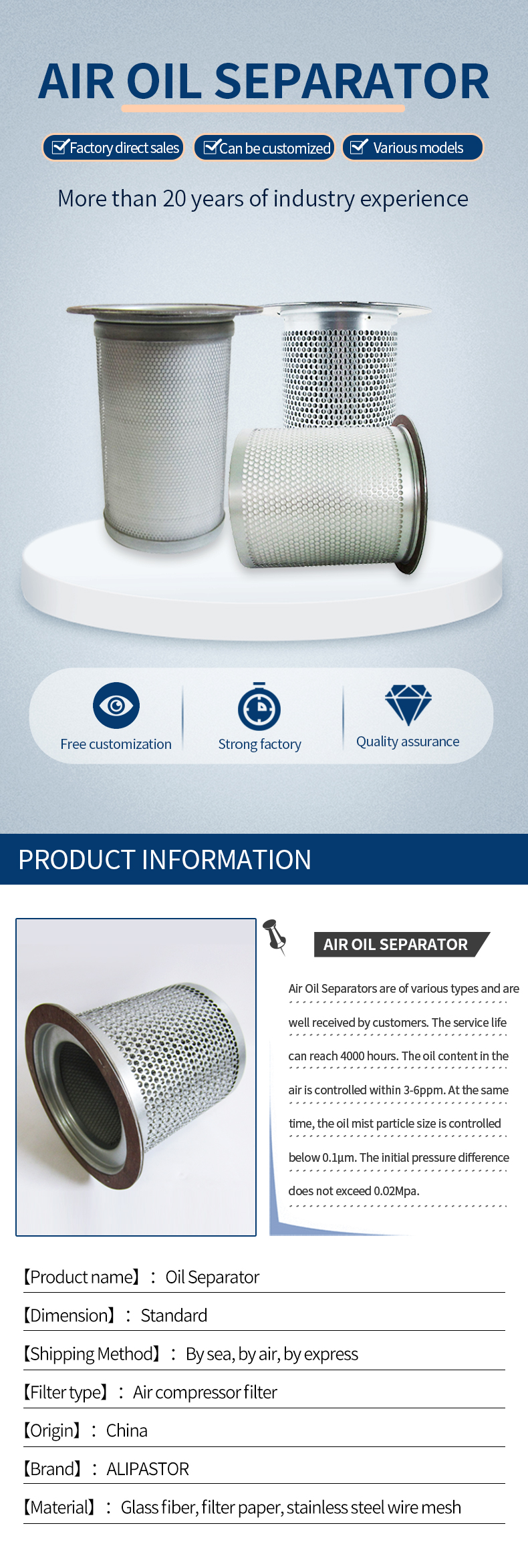
Type | Air Oil Separator | Material | Imported fiberglass |
Warranty | 6 Month | Machinery Test Report | Provided |
Video Outgoing-Inspection | Provided | Place of Origin | Henan, China |
Brand Name | ALIPASTOR | Application | for air compressor |
Product Name | Air Oil Separator | Part Number | KD900‑043 KV195‑008P KV100‑027 |
Keyword | Air Oil Separator | Weight | Standard |
Filtration | 10micron | Color | Customize |
Filtration Grade | 99% | Warranty | 3 Months |
Production Capacity | 1000 PCS/Week |
Product Parameters
Model Number | KD900‑043 KV195‑008P KV100‑027 |
Type | Air Oil Separator element |
Dimension | Standard |
Working Temperature | According to customer's request |
Work Pressure Different | Customized |
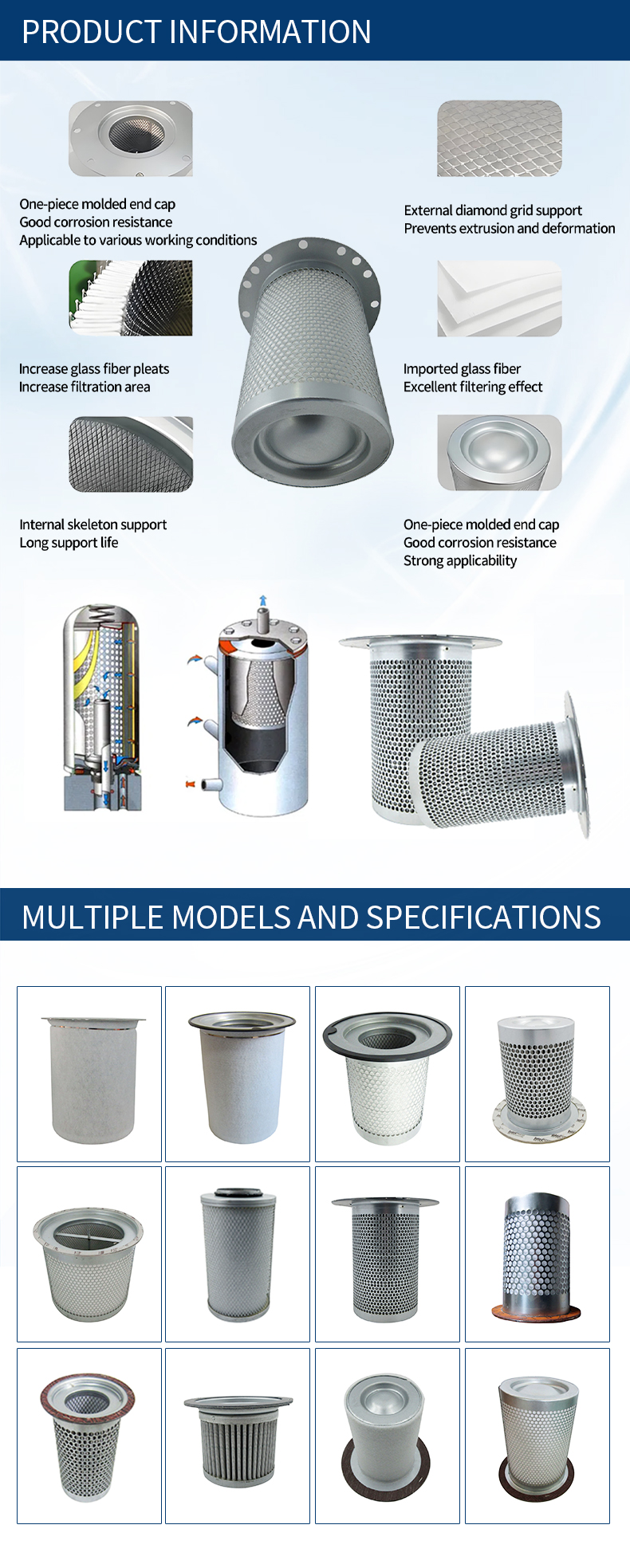
Material | Imported fiberglass |
Filter Precision | 10~20μm |
Life span | 2000h |
MOQ | 1 pieces |
Lead Time | Around 5-7 days after order confirmed |
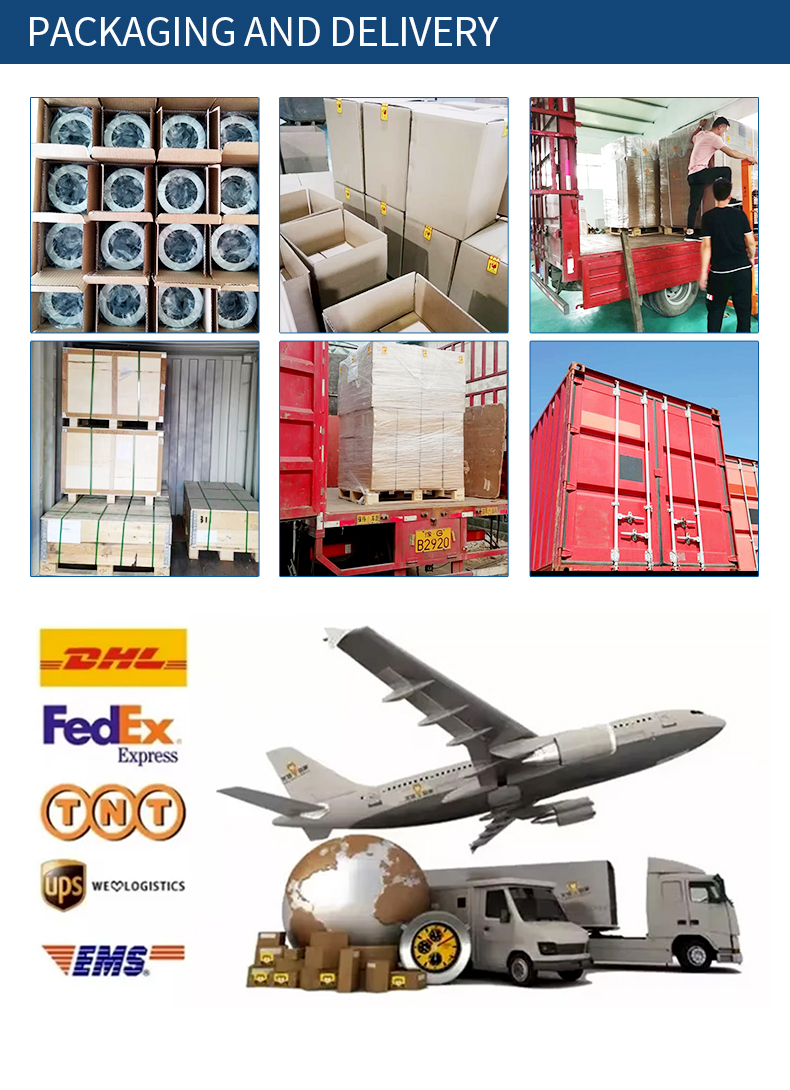
Package | PP bag inside, Inner carton, Export carton outside, or Wooden box as your requirement |
Shipping Method | By sea, by air, by express |
Air-Oil Separation Filter Elements – Models KD900-043 · KV195-008P · KV100-027
Three replacement elements for the final-stage air-oil separation in oil-flooded rotary screw air compressors. Each model corresponds to a distinct dimensional envelope and flow rating, but all share the same core technology: borosilicate glass-fiber coalescing media that captures oil aerosol droplets (0.1–1 µm) from the hot compressed air discharge, coalesces them into larger drops, and returns the lubricant to the compressor sump via the scavenge line — discharging clean compressed air with residual oil content of 2–5 ppm or below .
Key Features
Borosilicate glass-fiber media – standard for mineral oil and most synthetic lubricants; polyester/synthetic fibre available for aggressive fluids
Filtration accuracy: captures oil droplets down to 0.01–1 µm
Outlet oil content: 2–5 ppm w/w typical
Initial differential pressure: clean baseline 0.2–0.5 bar
Change-out differential pressure: 0.8–1.0 bar
Service life: 4,000 hours (mineral oil); 6,000–8,000 hours (synthetic lubricant)
Flow direction: Outside → Inside (air); oil returns via bottom scavenge port
Anti-static construction – conductive path to vessel ground
Configuration: spin-on type with threaded base, or bolt-in cartridge per compressor housing
Seal: NBR standard; FKM for high-temperature or aggressive lubricants
Technical Specifications
Parameter | KD900-043 | KV195-008P | KV100-027 |
|---|---|---|---|
Application | Rotary screw compressor final-stage separation | Same | Same |
Media | Borosilicate glass-fiber | Borosilicate glass-fiber | Borosilicate glass-fiber |
Outlet Oil Content | ≤ 3 ppm | ≤ 3 ppm | ≤ 3 ppm |
Body Diameter | 5.5 in (140 mm) | Verify against existing element | Verify against existing element |
Length | 11.75 in (298 mm) | Verify against existing element | Verify against existing element |
Thread / Mount | Spin-on, threaded base | Per housing | Per housing |
Initial ΔP | 0.2–0.5 bar | 0.2–0.5 bar | 0.2–0.5 bar |
Change-out ΔP | 0.8–1.0 bar | 0.8–1.0 bar | 0.8–1.0 bar |
Service Life | 4,000 h (mineral) / 6,000–8,000 h (synthetic) | Same | Same |
Flow Direction | Outside → Inside | Outside → Inside | Outside → Inside |
Seal Material | NBR (FKM optional) | NBR (FKM optional) | NBR (FKM optional) |
Compliance | ISO 8573-1; ISO 12500 (coalescing efficiency) | Same | Same |
📌 Dimensional note: KD900-043 measures 11.75 in height × 5.5 in OD . KV195-008P and KV100-027 dimensions must be verified against the existing element or compressor service manual before ordering — the correct outer diameter, inner diameter, height, scavenge port position, and rated working pressure must all be confirmed .
How It Works
The oil-laden compressed air from the compression stage enters the separator vessel and undergoes three sequential mechanisms :
Centrifugal & collision separation – larger oil droplets are flung to the vessel wall and drain to the bottom sump
Coalescence – remaining oil mist (0.1–1 µm) passes through the glass-fiber media; droplets contact fibers, merge, and grow
Scavenge return – large oil drops drain through the scavenge port at the base of the element, returning to the compressor oil circuit; clean air exits with ≤ 3 ppm residual oil
Application Guidance
These elements are installed in the separator vessel of:
Stationary and portable rotary screw air compressors
Refrigeration and natural gas compressor packages (special inorganic media variants available)
Vacuum pump oil-mist recovery systems
Replacement triggers — act immediately on any of the following :
Differential pressure across the separator exceeds 0.8–1.0 bar
Visible oil mist or wet filters at air outlets downstream
Unexplained rise in oil consumption with no external leak
More frequent high-temperature alarms
Scheduled intervals :
Mineral oil systems: every 4,000 operating hours or 12 months
Synthetic lubricant systems: every 6,000–8,000 operating hours or 12 months
Low-utilization compressors (< 2,000 h/year): replace annually regardless of hours
Why Correct Selection Matters
⚠️ Using an incompatible or substandard separator can drive oil carryover into the compressed air system, contaminate dryers and pneumatic equipment, force the compressor to run hotter, and in worst-case scenarios create fire or explosion hazards . A correctly specified element in good condition is the single most cost-effective protection for downstream equipment.
Fluid Compatibility
Mineral compressor lubricants — glass-fiber media, NBR seal standard
Semi-synthetic and full-synthetic compressor oils — extended service life
Aggressive fluids where glass fiber may degrade — polyester or synthetic fibre media required
Food-grade PAO lubricants — verify media compatibility with the supplier
Installation & Service
Switch off the compressor; allow to cool for at least 30 minutes.
Isolate electrical supply (LOTO procedure); close the main air delivery valve.
Open the manual blow-down valve; confirm the pressure gauge reads zero bar before opening any connection .
Disconnect the scavenge return line and control lines; label each for correct reassembly.
Remove the vessel cover; extract the spent element (disposable — never reuse).
Wipe the vessel interior with a lint-free cloth; contamination left inside will immediately compromise the new element's efficiency .
Lower the new element in, confirming correct orientation and that the scavenge port aligns precisely with the scavenge tube .
Lightly coat the top seal or O-ring with clean compressor oil to ensure even seating.
Refit the cover to the manufacturer's torque specification; reconnect the scavenge line.
Top up oil to the correct level; restore power; start and allow to reach normal operating temperature.
Check all connections for leaks; verify gauge returns to clean baseline 0.2–0.5 bar; log the replacement date, compressor hours, and part number in your service record .
Ordering
Specify the exact model (KD900-043, KV195-008P, or KV100-027) together with:
Host compressor model and rated displacement
Lubricant type (mineral / semi-synthetic / full-synthetic / food-grade PAO)
Required outlet oil grade (standard ≤ 10 ppm / high-efficiency ≤ 5 ppm / ultra-high-efficiency ≤ 3 ppm)
Element outer diameter, inner diameter, height, and scavenge port position
Rated working pressure (bar g)
Mounting style (spin-on or bolt-in)
Thread size or flange pattern
Provide a photo or sketch of the existing element for cross-reference if uncertain. Custom configurations can be accommodated — typical lead time 3–7 days.
All values nominal; KD900-043 measures 11.75 in height × 5.5 in OD, spin-on type . KV195-008P and KV100-027 dimensions must be verified against the existing element before ordering. All three models use borosilicate glass-fiber coalescing media, capture 0.1–1 µm oil droplets, and deliver outlet oil content of 2–5 ppm or below. Initial ΔP 0.2–0.5 bar; change-out ΔP 0.8–1.0 bar. Service life 4,000 h (mineral oil) or 6,000–8,000 h (synthetic lubricant). Compliant with ISO 8573-1 and ISO 12500 coalescing efficiency. Replace proactively at the change-out differential pressure or scheduled interval — whichever comes first.





Q2. Is customized filter or OEM available?
A: Yes,just offer your required sepcifications and drawings.
Q3. Can you produce according to the samples?
A: Yes,we can produce by your samples or technical drawings. We can build the molds and fixtures.
Q4.What's the terms of payment?
A: T/T 30% as deposit, and 70% before delivery. We'll show you the photos of the products and packages before you pay the balancing.
Q5.What's your terms of delivery?
A: (1)FOB (2)CFR (3)CIF.
Q6. How about your delivery time?
A: Generally, under MOQ quantity take 5-7 working days after receiving your advance payment. The specific delivery time depends on models and the quantity of your order.
Q7. What's your sample policy?
A: We can supply the sample if we have stock, but the customers have to pay the sample cost and the courier cost at first, and we will refund sample cost in your next order.


