
250028-033 Filter | Air/Oil Separator Element for Compressor Separator Vessels
What the 250028-033 Filter Actually Is
The 250028-033 filter in this context is most commonly used as an air/oil separator element inside a compressor separator vessel on rotary screw compressor systems.
Its job is to separate oil mist and liquid oil from the compressed air before the air leaves the tank, so downstream:
piping stays cleaner
tools and processes receive drier, lower-oil air
oil consumption stays under control
Think of it as the “final oil catcher” between the compressor package and your clean air system.
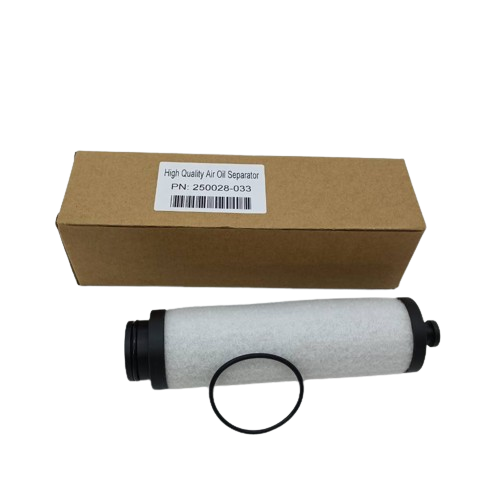
Quick Fitment & Specs Checklist (always verify before buying)
Item | What to check / typical range |
|---|---|
Part number | 250028-033 (element / cartridge) |
Fits | Separator vessel / separator housing designed for a spin-in or drop-in separator element (verify interface type) |
Type | Air/oil separator (coalescing-type separation, not a simple particulate panel filter) |
Media | Glass-fiber / coalescer media pack + perforated core + end caps/seals |
Seal/O-ring | Confirm groove style & material: NBR or FKM depending on temp & oil type |
Max working pressure | Often around 1.0–1.6 MPa (150–232 psi) — read the vessel nameplate |
Temp range | Roughly +2…+90 °C (35…194 °F) for standard duty (condensation/ambient matters) |
Mounting style | Threaded central stud / bayonet or threaded housing cap (model-specific) |
How to confirm fit | Compare: overall length/OD, stud size, O-ring groove position, and housing model from nameplate or parts drawing |
⚠️ Even if “250028-033” matches, a different O-ring material or groove can cause leaks. Match the element to the vessel, not just the number.

Signs It’s Time to Replace the 250028-033 Element
Rising separator differential pressure (ΔP)
(many systems trigger a service alert when ΔP approaches roughly 0.8–1.0 bar / 12–15 psi — follow your compressor manual’s exact limit)
Higher oil consumption / more oil at discharge (oil carryover jumps)
Foaming or unstable sump level after other causes (wrong oil, overfill, short-cycling) are ruled out
Scheduled interval reached (often inspected/replaced as part of routine separator service; hours vary by duty & environment)
Rule of thumb: don’t “run it until it collapses.” High ΔP adds load and can destabilize oil separation performance.
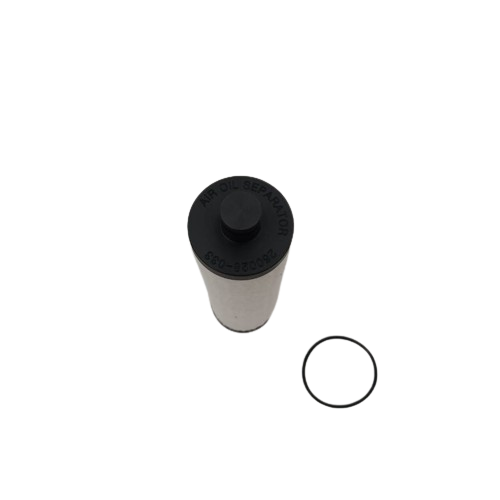
Safe Replacement Steps (minimal, practical)
Lock out / tag out the compressor and isolate discharge if fitted.
Slowly vent all pressure from the separator vessel (follow your system’s blow-down procedure).
Open the separator access cap / retainer, then lift or unscrew the old 250028-033 element straight out.
Inspect:
cap threads, sealing faces, O-ring grooves, and the central stud/boss
any deformation, dents, or sludge that hints at wrong element, overpressure, or water/oil contamination issues
Lightly lube the new element’s O-ring with compatible compressor oil (thin film only).
Seat the new element squarely (no cocking), reinstall the retainer/cap, and torque to the value stated in the compressor/separator instructions (hand-tight + a measured turn is fine onlyif your manual defines it).
Close drains, remove LOTO, restart, and watch ΔP / check for leaks during ramp-up.
Maintenance Tips That Save Money
Keep the separator drain trap working (water pooling under the element ruins separation).
Don’t overfill sump/oil—excess oil easily migrates into the air side.
If you changed oil type/viscosity, confirm the separator element & seals are rated for that chemistry.
Log operating hours + ΔP readings; the trend tells the truth earlier than “visual.”
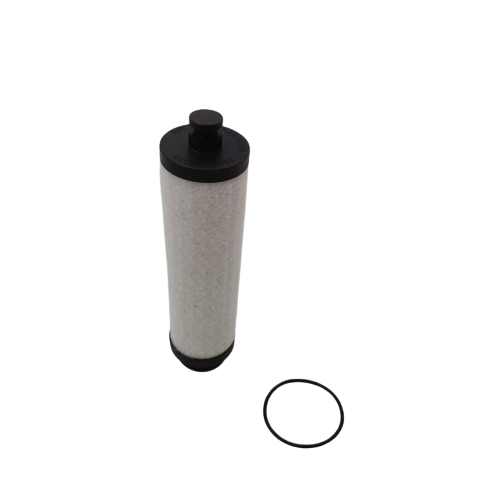
FAQ (short)
Q: Is 250028-033 a hydraulic oil filter or an engine oil filter?
A: In the vast majority of listings it appears as an air/oil separator element for compressors, not a spin-on engine/hydraulic filter. If yours looks like a small spin-on canister, stop and check the equipment nameplate—fitment may differ.
Q: Can I clean and reuse it?
A: Not recommended. Coalescer media relies on fiber structure; washing usually damages performance or pushes trapped oil back into the pack. Replace it.
Q: I only have the number—how do I confirm it’s the right element?
A: Send/photograph (1) vessel nameplate, (2) old element ends + any markings, (3) approximate dimensions. That’s enough to confirm interface & seal style without naming any OEM brand.


